Back
Back
What The Google Knowledge Panel Actually Is
(And Why It Matters More Than Your Website)
Dec 7, 2025
Most people think their online presence is "my website, my LinkedIn, a few podcasts, a couple of press hits." That is how humans count assets. Google does not see it that way. From Google’s perspective, you are either an entity it understands or you are noise blended in with millions of similar names. The most visible proof that Google has decided you are a real, distinct entity is the Google Knowledge Panel. It is the small box that quietly decides how serious you look when someone types your name into the search bar.
What is a Google Knowledge Panel?
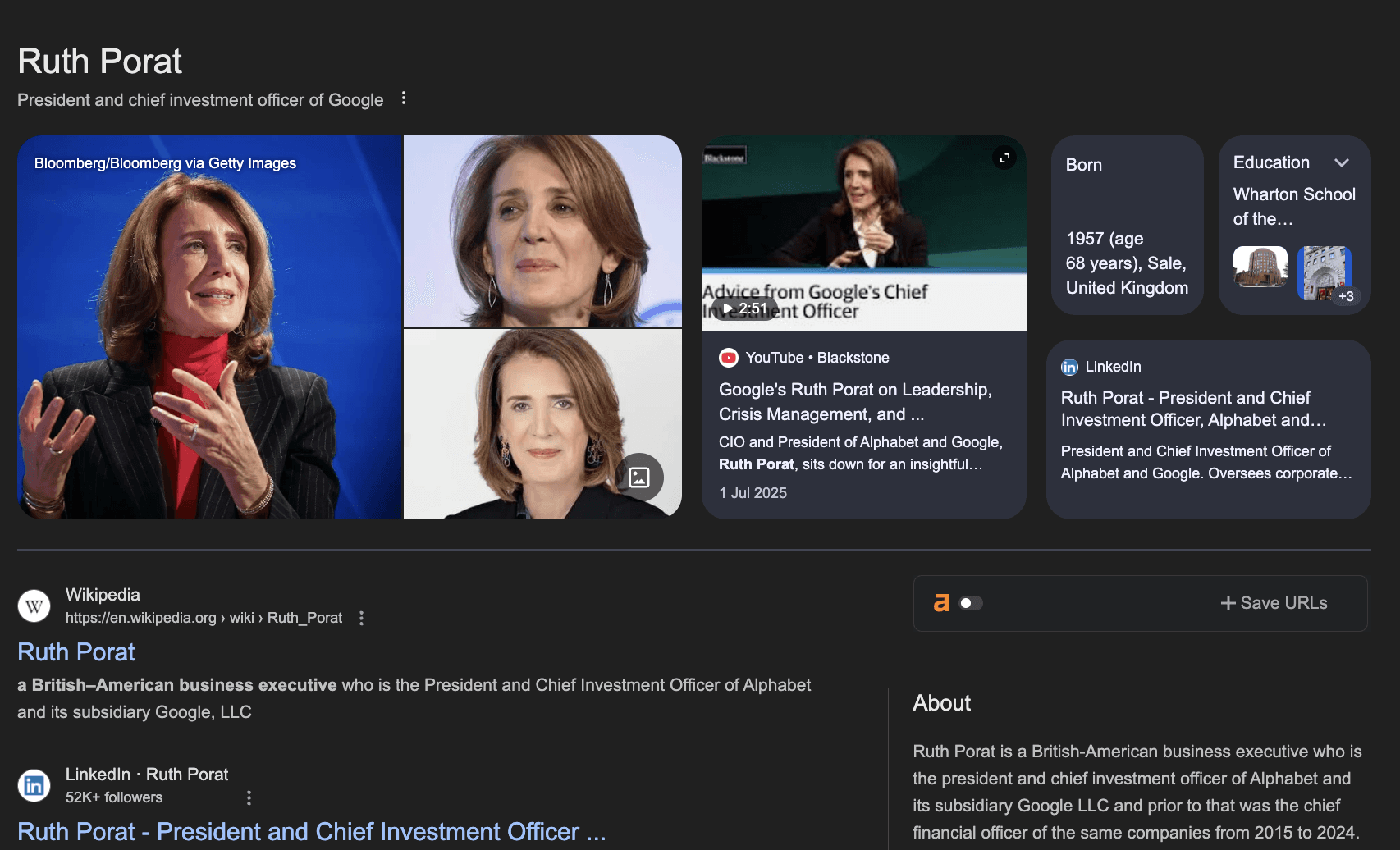
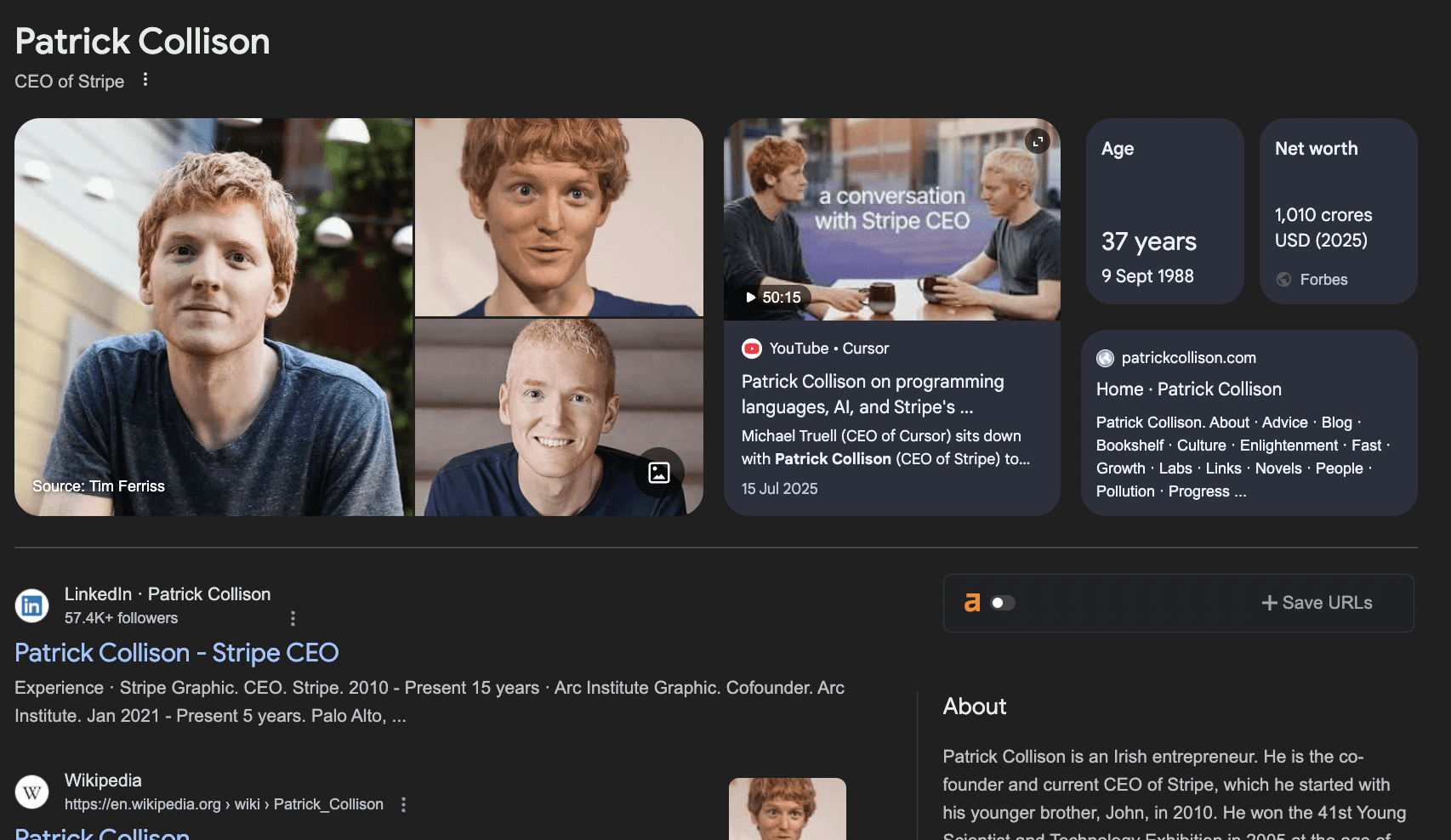
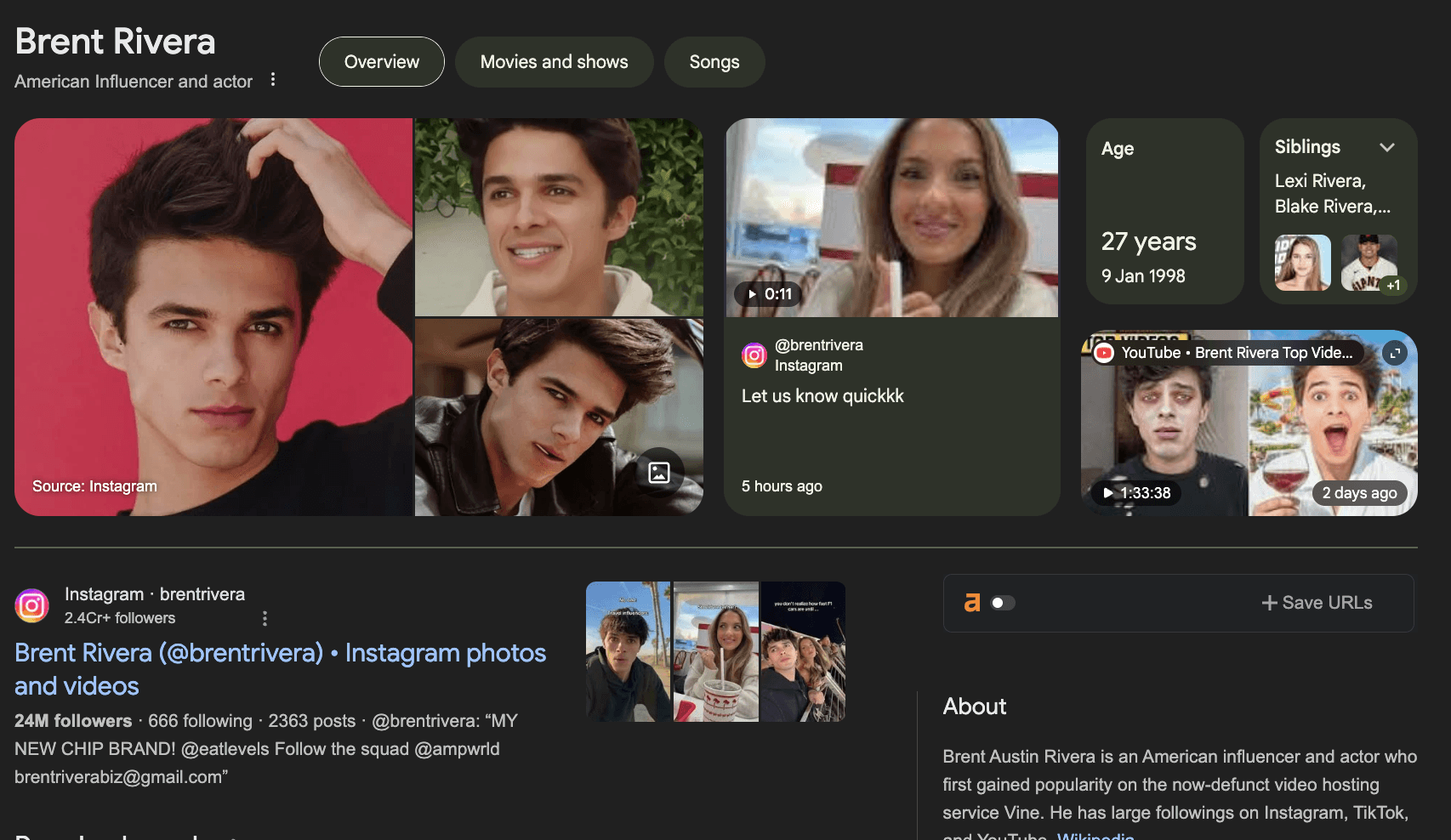
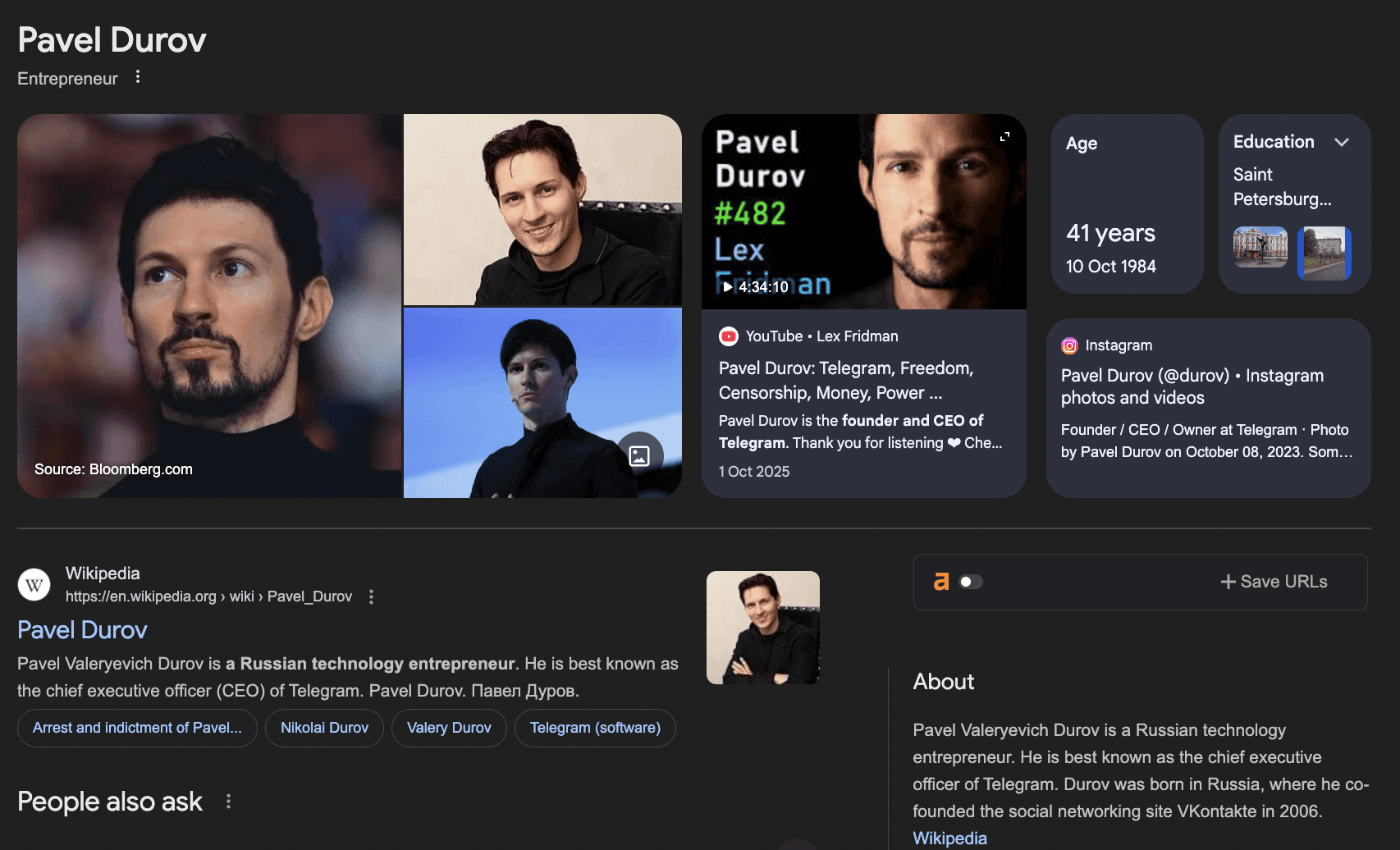
When you search a well known person or brand, you often see a box on the right side of desktop results, or at the top on mobile. It contains their name, photo, short description, role, company, and links to official profiles. Sometimes it shows books, music, social accounts, or other facts tied to that identity. That box is the Google Knowledge Panel.
Under the hood, the panel is fed by the Knowledge Graph, which is Google’s internal map of people, places, companies, and concepts. It is not just stacking links in order. It is saying: "We know who this person is, we have enough confidence to summarize them, and we are willing to show that summary as an authority object in search." For a human, it is just a neat visual widget. For algorithms and systems that sit on top of Google, it is a strong signal that you exist as a stable identity in the data.
Why it is such a strong asset
If you sell, raise money, speak publicly, recruit talent, or advise clients, you are already living inside a constant background check. People hear about you in a call, in a group chat, or on a podcast, and the very next step is usually the same: they Google your name. That moment is where the Knowledge Panel shows its leverage. This is not about vanity. It is about what your name looks like in the exact three seconds when someone is deciding whether to trust you or move on.
1. It upgrades the moment of the Google search
Think about the last time you were about to wire money to someone you did not know well. You probably searched their name, scanned the first few results, and built a vibe in your head: "solid operator," "unknown," "sketchy," "not sure." Your prospects and partners are doing the same thing to you.
If your search results are a random mix of directory listings, outdated profiles, and maybe a forgotten blog, you force people to work to understand you. That work feels like risk. On the other hand, if they see a Knowledge Panel with a clear photo, a concise description, your company, and links that look official, their brain relaxes. Google has already done some of the filtering. You move from "unverified stranger" to "probably safe and established" before you say a word. That shift does not just feel good. It shows up in bigger deal sizes, easier closes, and faster replies.
2. It turns scattered proof into a single story
Most high functioning people already have more credibility signals than they realize. Maybe you have been quoted in trade publications, spoken at niche conferences, appeared on a couple of podcasts, or built a strong LinkedIn and Twitter presence over the years. The problem is not the lack of proof. The problem is that it is fragmented across dozens of domains with different names, bios, photos, and time stamps.
The Knowledge Panel is what happens when all of that scattered proof gets reconciled into one coherent story. Google connects your various appearances in articles, your social profiles, your company website, and maybe your Wikipedia entry or database listings, and concludes "this is one person with this role and these key attributes." The panel is the visible result of that decision. It is like getting a clean, high level summary of your career written for you by the platform that everyone already uses as a default background checker.
This is useful for human beings, because they do not have to click ten links to figure out who you are. It is also useful for machines, including search ranking systems and large language models that read the web. When those systems see a distinct entity with structured data behind it, they treat you differently than a random name collision in a crowded field.
3. It gives you more control over how you appear
Without a Knowledge Panel, your "brand" in Google is essentially the sum of other people’s pages about you. Old speaker bios, outdated startup roles, stale photos, random directories. You get whatever happens to rank that month, with very few levers to adjust the picture.
Once a panel exists and you claim it through Google’s verification process, you gain a different level of influence. You can suggest corrections to basic facts if they are wrong, update photos, and refine which profiles Google links as your main presence. You cannot fully script the narrative, but you move from passive subject to active participant in how your identity is presented. Over time, small adjustments compound into a much more accurate, up to date image of who you actually are now, not who you were five years ago.
That sense of control matters more than people admit. Knowing that the first impression someone sees when they search your name is intentional and curated changes how comfortable you feel sending cold emails, asking for bigger checks, or walking into a room full of strangers who are going to Google you on their phone under the table.
4. It compounds over time
A Knowledge Panel is not a campaign with a start and end date. It behaves more like an infrastructure asset. Once it exists, it keeps doing its job quietly in the background. Every podcast appearance, every talk, every introduction someone makes for you routes people through the same improved Google page.
Over years, this has real compounding effects. Your inbound deal flow tends to improve because serious prospects feel reassured when they look you up. Journalists and conference organizers find it easier to quickly confirm that you are legitimate and relevant. People who want to introduce you to someone else feel more confident that you will reflect well on them. The panel alone does not create opportunities out of thin air, but it multiplies the yield of the attention you already generate, because that attention lands on a stronger, more coherent snapshot.
Who should care most?
It is easy to look at panels and assume they are only for celebrities, actors, and globally known founders. In reality, many of the people who benefit most are operating in narrower, high trust domains. A private equity partner, a specialist surgeon, a boutique law firm founder, a B2B SaaS consultant, a creator whose own name is the product. These are not always household names, but they move meaningful amounts of money, decisions, and careers around them.
If your work involves convincing strangers to trust your judgment, your ethics, or your competence, the moment they type your name into Google is a leverage point. A Knowledge Panel turns that moment from a question mark into a quiet endorsement. For a founder or CEO, that might mean investors feel more comfortable wiring funds or signing a term sheet. For a doctor or lawyer, it might mean prospective patients or clients feel safer choosing you instead of a random listing. For a creator or coach, it might mean higher ticket clients do not feel the need to interrogate your legitimacy in the first call.
Why most people do not have one yet
The interesting part is that there is no "sign up" button for a Knowledge Panel. You cannot just pay a subscription and flip a switch. Google needs to see a pattern in the wild that matches its idea of what makes an entity notable enough to summarize. That pattern includes consistent naming across the web, appearances on high trust sources, stable references in structured databases, and enough clarity that you are not confused with five other people who share your name.
This is why relatively obscure musicians or authors sometimes have panels while very wealthy operators do not. The system is biased toward clean, machine readable signals rather than revenue or private status. Most people who would genuinely benefit from a panel have never thought systematically about those signals. They assume "if I am successful enough, it will appear by itself," and sometimes it does, but very often it does not.
The gap between who "deserves" a panel and who actually has one is where a lot of the opportunity sits. If you care about how your name behaves in search, you can deliberately shape the inputs that Google reads, rather than waiting and hoping.
In short
A Google Knowledge Panel is more than a neat box on the side of the search results. It is a public sign that Google has understood you as a distinct entity, not just a list of links. It upgrades the critical moment when someone searches your name, turns scattered proof into a clean narrative, and gives you more influence over how you show up in the most important background check on the planet.
For people who operate in high trust, high stakes environments, that is not a cosmetic bonus. It is part of the trust infrastructure that every conversation quietly leans on. In a world where almost every meaningful interaction starts with a search, treating that panel as an afterthought is like leaving your front door half built.
Most people think their online presence is "my website, my LinkedIn, a few podcasts, a couple of press hits." That is how humans count assets. Google does not see it that way. From Google’s perspective, you are either an entity it understands or you are noise blended in with millions of similar names. The most visible proof that Google has decided you are a real, distinct entity is the Google Knowledge Panel. It is the small box that quietly decides how serious you look when someone types your name into the search bar.
What is a Google Knowledge Panel?
When you search a well known person or brand, you often see a box on the right side of desktop results, or at the top on mobile. It contains their name, photo, short description, role, company, and links to official profiles. Sometimes it shows books, music, social accounts, or other facts tied to that identity. That box is the Google Knowledge Panel.
Under the hood, the panel is fed by the Knowledge Graph, which is Google’s internal map of people, places, companies, and concepts. It is not just stacking links in order. It is saying: "We know who this person is, we have enough confidence to summarize them, and we are willing to show that summary as an authority object in search." For a human, it is just a neat visual widget. For algorithms and systems that sit on top of Google, it is a strong signal that you exist as a stable identity in the data.
Why it is such a strong asset
If you sell, raise money, speak publicly, recruit talent, or advise clients, you are already living inside a constant background check. People hear about you in a call, in a group chat, or on a podcast, and the very next step is usually the same: they Google your name. That moment is where the Knowledge Panel shows its leverage. This is not about vanity. It is about what your name looks like in the exact three seconds when someone is deciding whether to trust you or move on.
1. It upgrades the moment of the Google search
Think about the last time you were about to wire money to someone you did not know well. You probably searched their name, scanned the first few results, and built a vibe in your head: "solid operator," "unknown," "sketchy," "not sure." Your prospects and partners are doing the same thing to you.
If your search results are a random mix of directory listings, outdated profiles, and maybe a forgotten blog, you force people to work to understand you. That work feels like risk. On the other hand, if they see a Knowledge Panel with a clear photo, a concise description, your company, and links that look official, their brain relaxes. Google has already done some of the filtering. You move from "unverified stranger" to "probably safe and established" before you say a word. That shift does not just feel good. It shows up in bigger deal sizes, easier closes, and faster replies.
2. It turns scattered proof into a single story
Most high functioning people already have more credibility signals than they realize. Maybe you have been quoted in trade publications, spoken at niche conferences, appeared on a couple of podcasts, or built a strong LinkedIn and Twitter presence over the years. The problem is not the lack of proof. The problem is that it is fragmented across dozens of domains with different names, bios, photos, and time stamps.
The Knowledge Panel is what happens when all of that scattered proof gets reconciled into one coherent story. Google connects your various appearances in articles, your social profiles, your company website, and maybe your Wikipedia entry or database listings, and concludes "this is one person with this role and these key attributes." The panel is the visible result of that decision. It is like getting a clean, high level summary of your career written for you by the platform that everyone already uses as a default background checker.
This is useful for human beings, because they do not have to click ten links to figure out who you are. It is also useful for machines, including search ranking systems and large language models that read the web. When those systems see a distinct entity with structured data behind it, they treat you differently than a random name collision in a crowded field.
3. It gives you more control over how you appear
Without a Knowledge Panel, your "brand" in Google is essentially the sum of other people’s pages about you. Old speaker bios, outdated startup roles, stale photos, random directories. You get whatever happens to rank that month, with very few levers to adjust the picture.
Once a panel exists and you claim it through Google’s verification process, you gain a different level of influence. You can suggest corrections to basic facts if they are wrong, update photos, and refine which profiles Google links as your main presence. You cannot fully script the narrative, but you move from passive subject to active participant in how your identity is presented. Over time, small adjustments compound into a much more accurate, up to date image of who you actually are now, not who you were five years ago.
That sense of control matters more than people admit. Knowing that the first impression someone sees when they search your name is intentional and curated changes how comfortable you feel sending cold emails, asking for bigger checks, or walking into a room full of strangers who are going to Google you on their phone under the table.
4. It compounds over time
A Knowledge Panel is not a campaign with a start and end date. It behaves more like an infrastructure asset. Once it exists, it keeps doing its job quietly in the background. Every podcast appearance, every talk, every introduction someone makes for you routes people through the same improved Google page.
Over years, this has real compounding effects. Your inbound deal flow tends to improve because serious prospects feel reassured when they look you up. Journalists and conference organizers find it easier to quickly confirm that you are legitimate and relevant. People who want to introduce you to someone else feel more confident that you will reflect well on them. The panel alone does not create opportunities out of thin air, but it multiplies the yield of the attention you already generate, because that attention lands on a stronger, more coherent snapshot.
Who should care most?
It is easy to look at panels and assume they are only for celebrities, actors, and globally known founders. In reality, many of the people who benefit most are operating in narrower, high trust domains. A private equity partner, a specialist surgeon, a boutique law firm founder, a B2B SaaS consultant, a creator whose own name is the product. These are not always household names, but they move meaningful amounts of money, decisions, and careers around them.
If your work involves convincing strangers to trust your judgment, your ethics, or your competence, the moment they type your name into Google is a leverage point. A Knowledge Panel turns that moment from a question mark into a quiet endorsement. For a founder or CEO, that might mean investors feel more comfortable wiring funds or signing a term sheet. For a doctor or lawyer, it might mean prospective patients or clients feel safer choosing you instead of a random listing. For a creator or coach, it might mean higher ticket clients do not feel the need to interrogate your legitimacy in the first call.
Why most people do not have one yet
The interesting part is that there is no "sign up" button for a Knowledge Panel. You cannot just pay a subscription and flip a switch. Google needs to see a pattern in the wild that matches its idea of what makes an entity notable enough to summarize. That pattern includes consistent naming across the web, appearances on high trust sources, stable references in structured databases, and enough clarity that you are not confused with five other people who share your name.
This is why relatively obscure musicians or authors sometimes have panels while very wealthy operators do not. The system is biased toward clean, machine readable signals rather than revenue or private status. Most people who would genuinely benefit from a panel have never thought systematically about those signals. They assume "if I am successful enough, it will appear by itself," and sometimes it does, but very often it does not.
The gap between who "deserves" a panel and who actually has one is where a lot of the opportunity sits. If you care about how your name behaves in search, you can deliberately shape the inputs that Google reads, rather than waiting and hoping.
In short
A Google Knowledge Panel is more than a neat box on the side of the search results. It is a public sign that Google has understood you as a distinct entity, not just a list of links. It upgrades the critical moment when someone searches your name, turns scattered proof into a clean narrative, and gives you more influence over how you show up in the most important background check on the planet.
For people who operate in high trust, high stakes environments, that is not a cosmetic bonus. It is part of the trust infrastructure that every conversation quietly leans on. In a world where almost every meaningful interaction starts with a search, treating that panel as an afterthought is like leaving your front door half built.
Most people think their online presence is "my website, my LinkedIn, a few podcasts, a couple of press hits." That is how humans count assets. Google does not see it that way. From Google’s perspective, you are either an entity it understands or you are noise blended in with millions of similar names. The most visible proof that Google has decided you are a real, distinct entity is the Google Knowledge Panel. It is the small box that quietly decides how serious you look when someone types your name into the search bar.
What is a Google Knowledge Panel?
When you search a well known person or brand, you often see a box on the right side of desktop results, or at the top on mobile. It contains their name, photo, short description, role, company, and links to official profiles. Sometimes it shows books, music, social accounts, or other facts tied to that identity. That box is the Google Knowledge Panel.
Under the hood, the panel is fed by the Knowledge Graph, which is Google’s internal map of people, places, companies, and concepts. It is not just stacking links in order. It is saying: "We know who this person is, we have enough confidence to summarize them, and we are willing to show that summary as an authority object in search." For a human, it is just a neat visual widget. For algorithms and systems that sit on top of Google, it is a strong signal that you exist as a stable identity in the data.
Why it is such a strong asset
If you sell, raise money, speak publicly, recruit talent, or advise clients, you are already living inside a constant background check. People hear about you in a call, in a group chat, or on a podcast, and the very next step is usually the same: they Google your name. That moment is where the Knowledge Panel shows its leverage. This is not about vanity. It is about what your name looks like in the exact three seconds when someone is deciding whether to trust you or move on.
1. It upgrades the moment of the Google search
Think about the last time you were about to wire money to someone you did not know well. You probably searched their name, scanned the first few results, and built a vibe in your head: "solid operator," "unknown," "sketchy," "not sure." Your prospects and partners are doing the same thing to you.
If your search results are a random mix of directory listings, outdated profiles, and maybe a forgotten blog, you force people to work to understand you. That work feels like risk. On the other hand, if they see a Knowledge Panel with a clear photo, a concise description, your company, and links that look official, their brain relaxes. Google has already done some of the filtering. You move from "unverified stranger" to "probably safe and established" before you say a word. That shift does not just feel good. It shows up in bigger deal sizes, easier closes, and faster replies.
2. It turns scattered proof into a single story
Most high functioning people already have more credibility signals than they realize. Maybe you have been quoted in trade publications, spoken at niche conferences, appeared on a couple of podcasts, or built a strong LinkedIn and Twitter presence over the years. The problem is not the lack of proof. The problem is that it is fragmented across dozens of domains with different names, bios, photos, and time stamps.
The Knowledge Panel is what happens when all of that scattered proof gets reconciled into one coherent story. Google connects your various appearances in articles, your social profiles, your company website, and maybe your Wikipedia entry or database listings, and concludes "this is one person with this role and these key attributes." The panel is the visible result of that decision. It is like getting a clean, high level summary of your career written for you by the platform that everyone already uses as a default background checker.
This is useful for human beings, because they do not have to click ten links to figure out who you are. It is also useful for machines, including search ranking systems and large language models that read the web. When those systems see a distinct entity with structured data behind it, they treat you differently than a random name collision in a crowded field.
3. It gives you more control over how you appear
Without a Knowledge Panel, your "brand" in Google is essentially the sum of other people’s pages about you. Old speaker bios, outdated startup roles, stale photos, random directories. You get whatever happens to rank that month, with very few levers to adjust the picture.
Once a panel exists and you claim it through Google’s verification process, you gain a different level of influence. You can suggest corrections to basic facts if they are wrong, update photos, and refine which profiles Google links as your main presence. You cannot fully script the narrative, but you move from passive subject to active participant in how your identity is presented. Over time, small adjustments compound into a much more accurate, up to date image of who you actually are now, not who you were five years ago.
That sense of control matters more than people admit. Knowing that the first impression someone sees when they search your name is intentional and curated changes how comfortable you feel sending cold emails, asking for bigger checks, or walking into a room full of strangers who are going to Google you on their phone under the table.
4. It compounds over time
A Knowledge Panel is not a campaign with a start and end date. It behaves more like an infrastructure asset. Once it exists, it keeps doing its job quietly in the background. Every podcast appearance, every talk, every introduction someone makes for you routes people through the same improved Google page.
Over years, this has real compounding effects. Your inbound deal flow tends to improve because serious prospects feel reassured when they look you up. Journalists and conference organizers find it easier to quickly confirm that you are legitimate and relevant. People who want to introduce you to someone else feel more confident that you will reflect well on them. The panel alone does not create opportunities out of thin air, but it multiplies the yield of the attention you already generate, because that attention lands on a stronger, more coherent snapshot.
Who should care most?
It is easy to look at panels and assume they are only for celebrities, actors, and globally known founders. In reality, many of the people who benefit most are operating in narrower, high trust domains. A private equity partner, a specialist surgeon, a boutique law firm founder, a B2B SaaS consultant, a creator whose own name is the product. These are not always household names, but they move meaningful amounts of money, decisions, and careers around them.
If your work involves convincing strangers to trust your judgment, your ethics, or your competence, the moment they type your name into Google is a leverage point. A Knowledge Panel turns that moment from a question mark into a quiet endorsement. For a founder or CEO, that might mean investors feel more comfortable wiring funds or signing a term sheet. For a doctor or lawyer, it might mean prospective patients or clients feel safer choosing you instead of a random listing. For a creator or coach, it might mean higher ticket clients do not feel the need to interrogate your legitimacy in the first call.
Why most people do not have one yet
The interesting part is that there is no "sign up" button for a Knowledge Panel. You cannot just pay a subscription and flip a switch. Google needs to see a pattern in the wild that matches its idea of what makes an entity notable enough to summarize. That pattern includes consistent naming across the web, appearances on high trust sources, stable references in structured databases, and enough clarity that you are not confused with five other people who share your name.
This is why relatively obscure musicians or authors sometimes have panels while very wealthy operators do not. The system is biased toward clean, machine readable signals rather than revenue or private status. Most people who would genuinely benefit from a panel have never thought systematically about those signals. They assume "if I am successful enough, it will appear by itself," and sometimes it does, but very often it does not.
The gap between who "deserves" a panel and who actually has one is where a lot of the opportunity sits. If you care about how your name behaves in search, you can deliberately shape the inputs that Google reads, rather than waiting and hoping.
In short
A Google Knowledge Panel is more than a neat box on the side of the search results. It is a public sign that Google has understood you as a distinct entity, not just a list of links. It upgrades the critical moment when someone searches your name, turns scattered proof into a clean narrative, and gives you more influence over how you show up in the most important background check on the planet.
For people who operate in high trust, high stakes environments, that is not a cosmetic bonus. It is part of the trust infrastructure that every conversation quietly leans on. In a world where almost every meaningful interaction starts with a search, treating that panel as an afterthought is like leaving your front door half built.

Are you ready to convert more leads into customers?
Join 1000+ agencies, startups & consultants closing deals with Convert CRM
Are you ready to convert more leads into customers?
Join 1000+ agencies, startups & consultants closing deals with Convert CRM
Are you ready to convert more leads into customers?
Join 1000+ agencies, startups & consultants closing deals with Convert CRM
Latest posts
Discover other pieces of writing in our blog